|
openDAQ
Open data acquisition platform
|
|
openDAQ
Open data acquisition platform
|
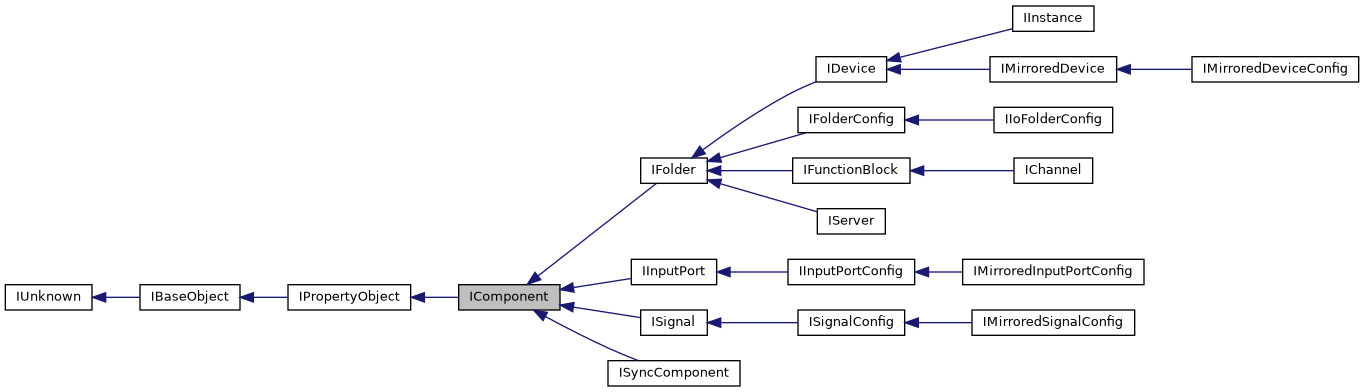
Acts as a base interface for components, such as device, function block, channel and signal. More...
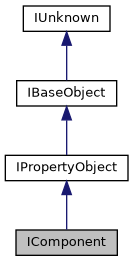
 Inheritance diagram for IComponent: Collaboration diagram for IComponent:
Acts as a base interface for components, such as device, function block, channel and signal.
The IComponent provides a set of methods that are common to all components: LocalID, GlobalID and Active properties.
Public Member Functions | |
| virtual ErrCode INTERFACE_FUNC | getLocalId (IString **localId)=0 |
| Gets the local ID of the component. More... | |
| virtual ErrCode INTERFACE_FUNC | getGlobalId (IString **globalId)=0 |
| Gets the global ID of the component. More... | |
| virtual ErrCode INTERFACE_FUNC | getActive (Bool *active)=0 |
| Returns true if the component is active; false otherwise. More... | |
| virtual ErrCode INTERFACE_FUNC | setActive (Bool active)=0 |
| Sets the component to be either active or inactive. Sets the local active state and notifies children about the parent active state change. More... | |
| virtual ErrCode INTERFACE_FUNC | getContext (IContext **context)=0 |
| Gets the context object. More... | |
| virtual ErrCode INTERFACE_FUNC | getParent (IComponent **parent)=0 |
| Gets the parent of the component. More... | |
| virtual ErrCode INTERFACE_FUNC | getName (IString **name)=0 |
| Gets the name of the component. More... | |
| virtual ErrCode INTERFACE_FUNC | setName (IString *name)=0 |
| Sets the name of the component. More... | |
| virtual ErrCode INTERFACE_FUNC | getDescription (IString **description)=0 |
| Gets the description of the component. More... | |
| virtual ErrCode INTERFACE_FUNC | setDescription (IString *description)=0 |
| Sets the description of the component. More... | |
| virtual ErrCode INTERFACE_FUNC | getTags (ITags **tags)=0 |
| Gets the tags of the component. More... | |
| virtual ErrCode INTERFACE_FUNC | getVisible (Bool *visible)=0 |
Gets visible metadata state of the component. More... | |
| virtual ErrCode INTERFACE_FUNC | setVisible (Bool visible)=0 |
Sets visible attribute state of the component. More... | |
| virtual ErrCode INTERFACE_FUNC | getLockedAttributes (IList **attributes)=0 |
| Gets a list of the component's locked attributes. The locked attributes cannot be modified via their respective setters. More... | |
| virtual ErrCode INTERFACE_FUNC | getOnComponentCoreEvent (IEvent **event)=0 |
| Gets the Core Event object that triggers whenever a change to this component happens within the openDAQ core structure. More... | |
| virtual ErrCode INTERFACE_FUNC | getStatusContainer (IComponentStatusContainer **statusContainer)=0 |
| Gets the container of Component statuses. More... | |
| virtual ErrCode INTERFACE_FUNC | findComponent (IString *id, IComponent **outComponent)=0 |
| Finds the component (signal/device/function block) with the specified (global) id. More... | |
| virtual ErrCode INTERFACE_FUNC | getOperationMode (OperationModeType *modeType)=0 |
| Gets the operation mode of the device. More... | |
| virtual ErrCode INTERFACE_FUNC | getLocalActive (Bool *localActive)=0 |
| Returns true if the component is local active; false otherwise. More... | |
| virtual ErrCode INTERFACE_FUNC | getParentActive (Bool *parentActive)=0 |
| Returns true if the component's parent is active; false otherwise. More... | |
| Public Member Functions inherited from IPropertyObject | |
| virtual ErrCode INTERFACE_FUNC | getClassName (IString **className)=0 |
| Gets the name of the class the Property object was constructed with. More... | |
| virtual ErrCode INTERFACE_FUNC | setPropertyValue (IString *propertyName, IBaseObject *value)=0 |
| Sets the value of the Property with the given name. More... | |
| virtual ErrCode INTERFACE_FUNC | getPropertyValue (IString *propertyName, IBaseObject **value)=0 |
| Gets the value of the Property with the given name. More... | |
| virtual ErrCode INTERFACE_FUNC | getPropertySelectionValue (IString *propertyName, IBaseObject **value)=0 |
| Gets the selected value of the Property, if the Property is a Selection property. More... | |
| virtual ErrCode INTERFACE_FUNC | clearPropertyValue (IString *propertyName)=0 |
| Clears the Property value from the Property object. More... | |
| virtual ErrCode INTERFACE_FUNC | hasProperty (IString *propertyName, Bool *hasProperty)=0 |
Checks if the Property object contains a property named propertyName. More... | |
| virtual ErrCode INTERFACE_FUNC | getProperty (IString *propertyName, IProperty **property)=0 |
Gets the Property with the given propertyName. More... | |
| virtual ErrCode INTERFACE_FUNC | addProperty (IProperty *property)=0 |
| Adds the property to the Property object. More... | |
| virtual ErrCode INTERFACE_FUNC | removeProperty (IString *propertyName)=0 |
Removes the Property named propertyName from the Property object. More... | |
| virtual ErrCode INTERFACE_FUNC | getOnPropertyValueWrite (IString *propertyName, IEvent **event)=0 |
Gets the Event that is triggered whenever a Property value is written to the Property named propertyName. More... | |
| virtual ErrCode INTERFACE_FUNC | getOnPropertyValueRead (IString *propertyName, IEvent **event)=0 |
Gets the Event that is triggered whenever a Property value of a Property named propertyName is read. More... | |
| virtual ErrCode INTERFACE_FUNC | getOnAnyPropertyValueWrite (IEvent **event)=0 |
| Gets the Event that is triggered whenever any Property value is written. The event is triggered after the specific Property event. More... | |
| virtual ErrCode INTERFACE_FUNC | getOnAnyPropertyValueRead (IEvent **event)=0 |
| Gets the Event that is triggered whenever any Property value is read.The event is triggered after the specific Property event. More... | |
| virtual ErrCode INTERFACE_FUNC | getVisibleProperties (IList **properties)=0 |
| Returns a list of visible properties contained in the Property object. More... | |
| virtual ErrCode INTERFACE_FUNC | getAllProperties (IList **properties)=0 |
| Returns a list of all properties contained in the Property object. More... | |
| virtual ErrCode INTERFACE_FUNC | setPropertyOrder (IList *orderedPropertyNames)=0 |
| Sets a custom order of properties as defined in the list of property names. More... | |
| virtual ErrCode INTERFACE_FUNC | beginUpdate ()=0 |
| Begins batch configuration of the object. More... | |
| virtual ErrCode INTERFACE_FUNC | endUpdate ()=0 |
| Ends batch configuration of the object. More... | |
| virtual ErrCode INTERFACE_FUNC | getUpdating (Bool *updating)=0 |
| Returns the state of batch configuration. More... | |
| virtual ErrCode INTERFACE_FUNC | getOnEndUpdate (IEvent **event)=0 |
| Gets the Event that is triggered whenever the batch configuration is applied. More... | |
| virtual ErrCode INTERFACE_FUNC | getPermissionManager (IPermissionManager **permissionManager)=0 |
| Gets the permission manager of property object. More... | |
| virtual ErrCode INTERFACE_FUNC | findProperties (IList **properties, ISearchFilter *propertyFilter, ISearchFilter *componentFilter=nullptr)=0 |
| Retrieves a list of properties from the Property object that match the given property filter. More... | |
| virtual ErrCode INTERFACE_FUNC | setPropertySelectionValue (IString *propertyName, IBaseObject *value)=0 |
| Sets the value of a Selection property by the selection item value (e.g. string, float, or list/dict value). More... | |
| virtual ErrCode INTERFACE_FUNC | clearPropertyValues ()=0 |
| Clears values of all properties contained in the Property object, including nested child properties. More... | |
| Public Member Functions inherited from IBaseObject | |
| virtual ErrCode INTERFACE_FUNC | borrowInterface (const IntfID &intfID, void **obj) const =0 |
| Returns another interface which is supported by the object without incrementing the reference count. More... | |
| virtual ErrCode INTERFACE_FUNC | dispose ()=0 |
| Disposes all references held by the object. More... | |
| virtual ErrCode INTERFACE_FUNC | getHashCode (SizeT *hashCode)=0 |
| Returns hash code of the object. More... | |
| virtual ErrCode INTERFACE_FUNC | equals (IBaseObject *other, Bool *equal) const =0 |
| Compares object to another object for equality. More... | |
| virtual ErrCode INTERFACE_FUNC | toString (CharPtr *str)=0 |
| Returns a string representation of the object. More... | |
| Public Member Functions inherited from IUnknown | |
| virtual ErrCode INTERFACE_FUNC | queryInterface (const IntfID &intfID, void **obj)=0 |
| Returns another interface which is supported by the object and increments the reference count. More... | |
| virtual int INTERFACE_FUNC | addRef ()=0 |
| Increments the reference count for an interface on an object. More... | |
| virtual int INTERFACE_FUNC | releaseRef ()=0 |
| Decrements the reference count for an interface on an object. More... | |
|
pure virtual |
Finds the component (signal/device/function block) with the specified (global) id.
| id | The id of the component to search for. | |
| [out] | outComponent | The resulting component. |
If the component parameter is true, the starting component is the root device.
The id provided should be in relative form from the starting component. E.g., to find a signal in the starting component, the id should be in the form of "Dev/dev_id/Ch/ch_id/Sig/sig_id.
Returns true if the component is active; false otherwise.
| [out] | active | True if the component is active; false otherwise. |
A component is active if its local active state is true and its parent is active. An active component acquires data, performs calculations and send packets on the signal path.
Gets the context object.
| [out] | context | The context object. |
Gets the description of the component.
| [out] | description | The description of the component. Empty if not configured. |
The object that implements this interface defines how the description is specified.
Gets the global ID of the component.
| [out] | globalId | The global ID of the component. |
Represents the identifier that is globally unique. Globally unique identifier is composed from local identifiers from the parent components separated by '/' character. Device component must make sure that its ID is globally unique.
Returns true if the component is local active; false otherwise.
| [out] | localActive | True if the component is local active; false otherwise. |
An active component acquires data, performs calculations and send packets on the signal path. Note that is local active is True, the component may still be inactive if its parents are inactive.
Gets the local ID of the component.
| [out] | localId | The local ID of the component. |
Represents the identifier that is unique in a relation to the parent component. There is no predefined format for local ID. It is a string defined by its parent component.
Gets a list of the component's locked attributes. The locked attributes cannot be modified via their respective setters.
| [out] | attributes | A list of strings containing the names of locked attributes in capital case (eg. "Name", "Description"). |
Gets the name of the component.
| [out] | name | The name of the component. Local ID if name is not configured. |
The object that implements this interface defines how the name is specified.
|
pure virtual |
Gets the Core Event object that triggers whenever a change to this component happens within the openDAQ core structure.
| [out] | event | The Core Event object. The event triggers with a Component reference and a CoreEventArgs object as arguments. |
The Core Event is triggered on various changes to the openDAQ Components. This includes changes to property values, addition/removal of child components, connecting signals to input ports and others. The event type can be identified via the event ID available within the CoreEventArgs object. Each event type has a set of predetermined parameters available in the parameters field of the arguments. These can be used by any openDAQ server, or other listener to react to changes within the core structure.
|
pure virtual |
Gets the operation mode of the device.
| [out] | modeType | The current operation mode. |
|
pure virtual |
Gets the parent of the component.
| [out] | parent | The parent of the component. |
Every openDAQ component has a parent, except for instance. Parent should be passed as a parameter to the constructor/factory. Once the component is created, the parent cannot be changed.
Returns true if the component's parent is active; false otherwise.
| [out] | parentActive | True if the component's parent is active; false otherwise. |
|
pure virtual |
Gets the container of Component statuses.
| [out] | statusContainer | The container of Component statuses. |
Gets the tags of the component.
| [out] | tags | The tags of the component. |
Tags are user definable labels that can be attached to the component.
Gets visible metadata state of the component.
| [out] | visible | True if the component is visible; False otherwise. |
Visible determines whether search/getter methods return find the component by default.
Sets the component to be either active or inactive. Sets the local active state and notifies children about the parent active state change.
| active | The new local active state of the component. |
| OPENDAQ_IGNORED | if "Active" is part of the component's list of locked attributes, or if the new active value is equal to the previous. |
An active component acquires data, performs calculations and send packets on the signal path.
Sets the description of the component.
| description | The description of the component. |
| OPENDAQ_IGNORED | if "Description" is part of the component's list of locked attributes, or if the new description value is equal to the previous. |
The object that implements this interface defines how the description is specified.
Sets the name of the component.
| name | The name of the component. |
| OPENDAQ_IGNORED | if "Name" is part of the component's list of locked attributes, or if the new name value is equal to the previous. |
The object that implements this interface defines how the name is specified.
Sets visible attribute state of the component.
| visible | True if the component is visible; False otherwise. |
| OPENDAQ_IGNORED | if "Visible" is part of the component's list of locked attributes. |
Visible determines whether search/getter methods return find the component by default.
 1.9.3
1.9.3